
How to return to yourself — A simple nature-based practice
Updated: Mar 31
The Origins of the Strangler Fig — A Metaphor for Transformation
There is, in tropical forests, a tree whose way of growing invites deep reflection.
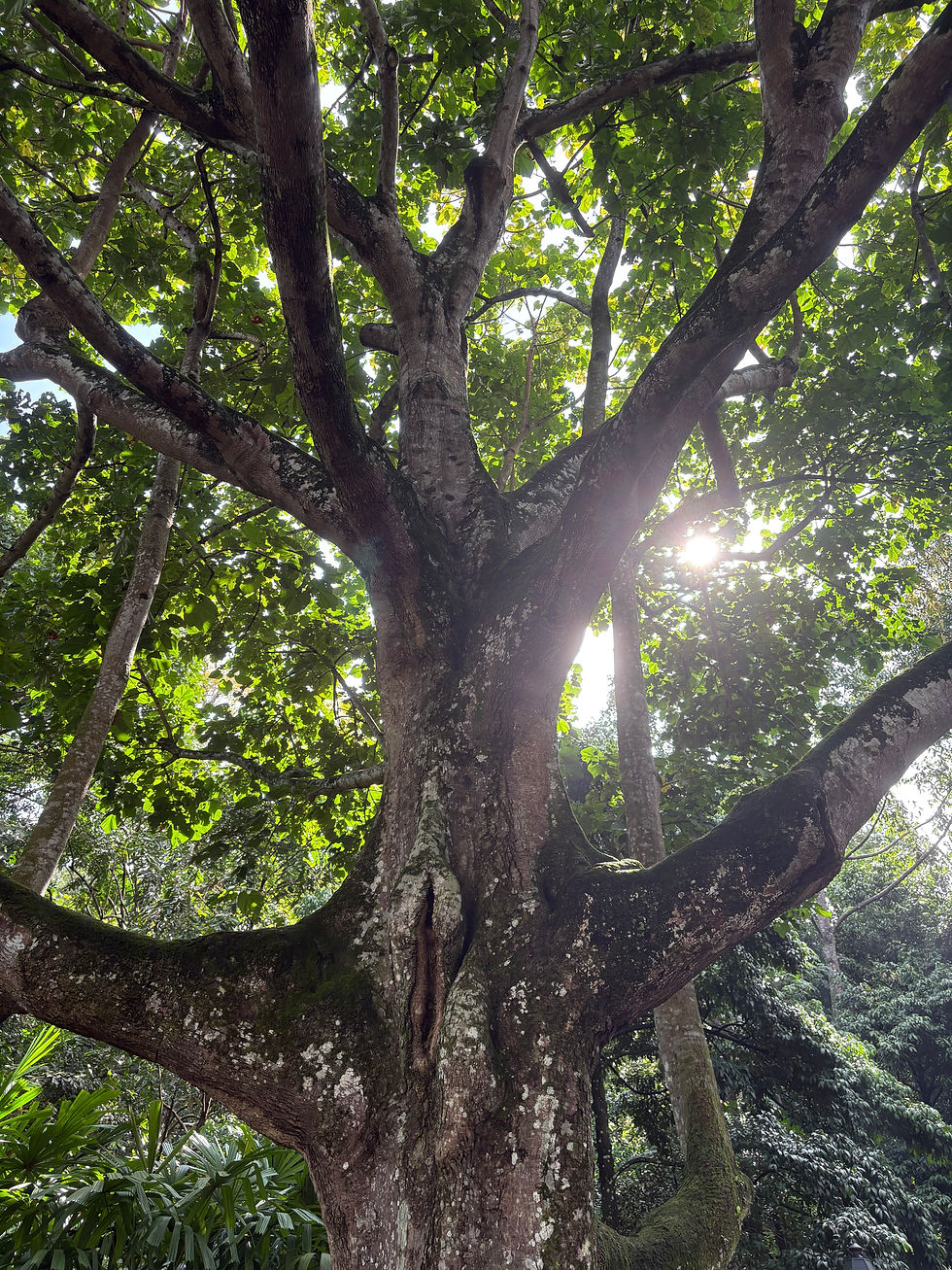
The strangler fig does not begin its life in the soil. Its seed settles on another tree, often carried by a bird. There, high above the ground, it finds its first support. It grows thanks to a structure that is not its own.
Then, with time, it descends.
Roots unfold, searching for the earth, anchoring themselves into it. Slowly, the fig develops its own strength, its own verticality, its own autonomy. The host tree may gradually disappear — not through intentional violence, but because a new form of life comes to take its place.

Reconnecting with Oneself — Growing One’s Own Roots
This image stays with me when I reflect on what it means to return to oneself.
Returning to oneself does not mean going backwards.
It is not about finding an untouched or original version of who we were. We all come into life in relation to others: parents, culture, history, frameworks that existed before us. At the beginning, we are carried.
But there comes a moment when something begins to move.
A subtle impulse, sometimes difficult to name. An inner movement that urges us to find support differently, to grow our own roots, to find our own ground.
This passage is not a rupture.
It feels more like a quiet transformation.
Returning to oneself means saying yes to this transforming life impulse.
It means accepting that we are no longer defined solely by what shaped us, while remaining deeply connected to that origin.
There is often sadness in this movement. A form of nostalgia. Because moving forward changes our relationships. Certain ways of being together cannot remain the same. Not because love disappears, but because life changes shape.
Returning to Oneself — Choosing Oneself Without Breaking from One’s Origins
The strangler fig reveals this paradox:
we do not grow by cutting our roots, but by integrating them.
What once carried us gradually stops being external.
It becomes an inner presence, a living memory, a quiet strength that accompanies us without holding us back.
So returning to oneself could mean this:
moving forward,
without denying what has shaped us,
allowing transformation to do its work,
and accepting the responsibility of fully inhabiting one’s own life.
Perhaps growing does not mean separating, but continuing differently.
Like the fig tree, it is not about erasing the origin.
It is about becoming the place where what has been transmitted to us can continue to live — in a new form.
Comments